Patio materials: a guide to choosing
Weigh appearance, feel, format, arrangement and care so your choice follows the way you want to use the space.
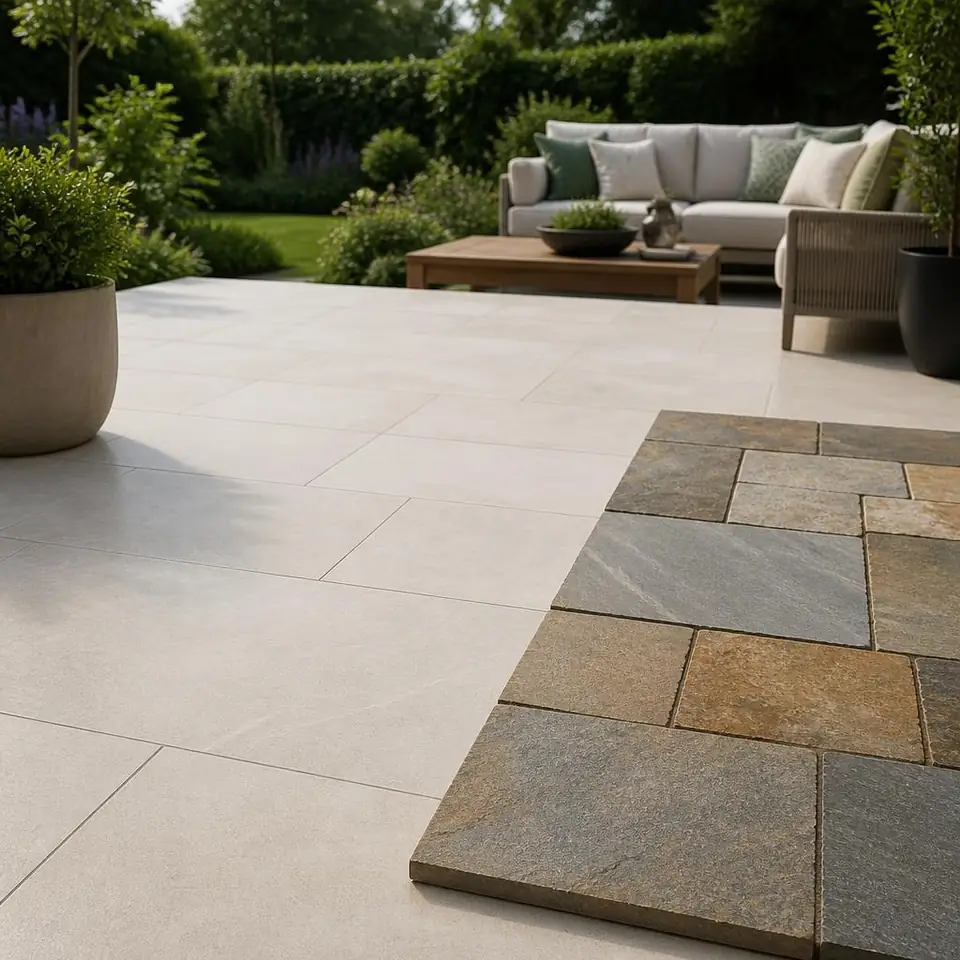
Start with the use of the space
Begin with how the patio will be used rather than with a product label. Mark out seating, a table, a barbecue, planting, steps and the route to the garden. Then consider the look you want beside the house and any existing surface. This gives you a practical brief for weighing swatches.
- For a quiet, consistent arrangement, weigh regular formats and restrained colour variation.
- For a more varied setting, consider natural changes in tone, shape and texture.
- For a defined layout, compare format, borders and repeatable modules.
- For an easy-to-read plan, mark thresholds, steps, covers and furniture before selecting sizes.
Compare the main material groups
| Material | What to inspect | Useful question |
|---|---|---|
| Porcelain | Consistent dimensions, printed or textured face, edge detail and grout or joint approach. | Does the chosen face and format suit the light, furniture and intended use? |
| Natural stone | Variation in colour, texture, thickness and the character of individual pieces. | How will the pieces be selected and arranged so the variation feels deliberate? |
Choose by appearance and texture
View porcelain and natural-stone samples beside the building and in more than one type of daylight. Porcelain can offer a consistent visual pattern, while natural stone varies between pieces. Inspect the exact product closely and from normal standing distance before deciding.
Inspect the details of the product
Product terms can describe details that change the appearance of an arrangement. Confirm whether an edge is sawn, tumbled, riven or rectified, and whether the stated sizes are calibrated. Match these terms to the actual swatch, not to a quality ranking.
Also inspect corners, colour variation, the back of a swatch and the face at an angle. For a step or raised border, confirm how the visible edge and any coping detail will be formed. A scaled drawing can show where narrower cuts, awkward corners and changes in module will occur.
Test the choice against the garden
View the sample from the kitchen, seating area and garden entrance, not only from directly above it. Note the sightlines, planting palette, colour of the brick or render and tone of nearby timber boundaries. A surface that looks balanced on a small board may read differently across a larger area.
Check the proposed joint colour beside the paving, then consider furniture scale and the amount of shade. Keep a labelled sample board or photograph of the chosen combination so later decisions about pots, walls and planting can refer back to it.
Check format, pattern and edges
Large formats can create fewer visible joints, while smaller units can offer more arrangement choices. Neither approach is automatically right: the best fit depends on the proportions of the space and the details around it.
Large-format arrangement
Check handling, cuts, joint alignment and the way the grid meets the building.
Mixed-format arrangement
Confirm the repeat and request a scaled drawing before approving the composition.
Borders
Decide whether the border frames the whole area or only defines a route or seating zone.
Transitions
Review steps, thresholds, covers, walls and planting edges as part of the same drawing.
Ask about care without making assumptions
Care instructions vary with the product, face, joint material and surrounding conditions. Request the manufacturer’s guidance for the exact product rather than assuming that all patios can be cleaned in the same way.
- Which brush and cleaning products are suitable?
- Is the finish sensitive to strong pressure or particular treatments?
- How should joints be checked and refreshed?
- What should be done if a unit is stained, chipped or displaced?
Make the written quote comparable
Send each contractor the same sketch, sample reference and photographs of access, doors, steps, covers and neighbouring surfaces. Request a written specification naming the product, format, colour or blend, arrangement, edging, joints and preparation.
Check what is included and excluded, how changes will be agreed and what care information will be supplied. For the relevant service information, see the patio services page, or return to the blog for other comparisons.
Request a written patio quote
Include your preferred material, approximate area and access details when you get in touch. Driveway and Patio Kent is fully insured and free written quotes are available.